Waiting Room

by Jozlyn Burky

Page 1: Waiting Room
Ms. Farris brings you to one of her meetings she forgot about. This leaves you in a lobby, left to pay for her mistake with an empty chair and dinky clock, with only a TV to save you. All of this could’ve been avoided—walking through the forest from the school to her house isn’t terrifying—but she snatched you off the sidewalk, your grumbling driven over by the car’s wheels. 
She’s usually good at remembering her schedule, using notebooks and sticky notes, single-handedly keeping the businesses running. Though she forgot this time and forced you in the car, without forewarning, didn’t acknowledge her mistake, and now dropped you in a lobby all alone. 
“It won’t be long,” she promised before disappearing down the hallway. 
You put your ear to the door, cheek sucked between your teeth, counting one, two, three voices. None of it sounds like English. It’s like swimming underwater, ears clogged up, or when the organs drown out Ms. Farris’ singing in church.
But unlike lifeguards and stained glass, Ms. Farris can hear you. She’d save you if you were in danger, but dying of boredom doesn’t count as an emergency. 
You drag your feet down the hallway, kick up carpet like it’s dirt, pass by paintings of woods and forests, nothing original in this unoriginal place. You plop down on a creaky chair, smack the smelly newspaper to the ground, let old, stupid news fall beneath you. 
A news channel isn’t any better. Everyone’s seen car-busy highways, clumps of people outside schools, libraries, and stores. You can’t find the remote, either. Maybe Ms. Farris took  it as revenge because you didn’t talk to her in the car. If she did, maybe it’s time to ask for a new foster parent. 
Puzzles are left on the coffee table, worn with crushed edges. No point putting them together when you know they all have missing pieces. Also, they’ve got more dust than color. The books on the shelves could be entertaining if you were five, or old, like Ms. Farris kind of old, almost 40.
Page 2: The clock’s hour hand bonks the next minute.
Only one other person is in this lobby, so it’s worth walking to the front desk to start 
a conversation. It’s a kid asking an adult for help. You’ll get something out of it. 
The woman doesn’t look up, glasses sunk deep into the wrinkles on her cheeks. Somehow, it’s poorer than origami snowflakes. 
“Excuse me?” You grip the edge of the desk, toes arched. “Hello?”
She sets her sudoku book down, her numbers scratched on the page. Pleasant smile. 
“Is there something I can help you with, sweetie?”
“Do you have any games I can play with? All the puzzles have missing pieces, the books are for babies, the newspapers stink, and I can’t hear the TV because the remote’s gone.” 
She swallows, disappointed in your tone. “What’s your name?” 
Inevitably, all conversations start with that question. Like adults need indicators to follow a basic conversation. “Finley.” 
“You’re one of Janice’s kids, aren’t you? Janice Farris?” She doesn’t give her name. “She’s not my mother.” No way are you related to someone named Janice. Ms. Farris 
has wiry hair, angular cheekbones, and says your aunt’s out of town when really, she didn’t want you.
Estrangement’s your favorite word, but Ms. Farris tries to get you to like words like bravery, honesty, joy. 
“My bad, I didn’t mean it like that. Do you like to draw? I can get some paper and pencils?” 
“No.” Her workbook rests a few inches away.
“You wouldn’t be interested in sudoku.” 
“Why?” 
“Well, someone as young as you shouldn’t waste time over something like this.” If it’s 
a waste of time, then she shouldn’t be playing it. She doesn’t have much time left. 
“I’m nine.” One year older from not knowing how to spell schizophrenia, chandelier,
Page 3: 
and myriad. Two years older from getting mathematics and history stuck like gum in your hair. Three years older since not talking to anyone in a foster home after the car crash. Sudoku is the least of all challenging things. 
“How about I look for some paper and pencils? My niece’s about your age, and she loves coloring.” She doesn’t wait for a response, leaves like Ms. Farris. She was supposed to argue with you about sudoku. Her name must be Lucy. There was a Lucy in kindergarten that never listened to anyone. 
And like classmate Lucy, she’s got the wrong numbers written down, but it’s sudoku, not homework. But unlike classmate Lucy, there’s no reason to dislike this Lucy, even if she did leave you—adults are good at it, so you can’t be mad at something they do every month or so. You fix her three with an eight, mimic her handwriting as best as you can, but it’s tiny. No wonder she wears glasses, you have to squint to read it. 
“Go sit over there,” Lucy instructs, handing you crumpled paper and unsharpened pencils.
“What about pens for colors?” She digs through drawers, and you stamp a random four and seven in the grids. Items collected, you snicker and trot back to the waiting room, the nonsensical television blabbering to your empty chair. 
The newspaper’s still below the coffee table, but you skim the headlines one last time, confirm every headline’s got an obvious solution, an even blander hook.
Local Community Plants Trees with $5,000 donation, and now morale’s high, so people raised money to plant and save the trees. Nathaniel and Abby Photography Exhibition Opens, and people are interested to see what some photographer found picture-worthy in Nathaniel and Abby. High School Freshman Makes Pole-Vaulting Record, and people in high school must be pathetic to call that noteworthy. 
You could write something more interesting than the newspaper—the competition’s not hard, a lot of things are better than trees, photographs, pole vaulting. Surprise Lucy with the papers she wants to see pretty drawings on, something like the same-old paintings on the walls,
Page 4: but not like the same-old paintings—you’ll create something new. 
Dividing a paper for each story, you scrawl titles across the top. “Split into Pieces”, 
“Moments”, and “Fairview High”, something more mysterious than whatever titles newspapers think are exciting. Your hand cramps, but you pencil a better story, something new spilling underneath your nose, racing your through head. 
“Split Into Pieces”: an old oak tree got hacked into a million pieces because it caused lots of wrecks on the road, but instead of burning it, people chopped it into furniture, like the chair you’re sitting on, table you’re writing on, the paper in Lucy’s sudoku book. 
“Moments”: a photographer took one incredible picture of a little girl, and that picture got loads of attention, lots of money, and he gave the girl some of his earnings so she could buy a hot air balloon to go to Heaven and see her family again. 
“Fairview High”: a high school pole vaulting team realized that pole vaulting was only winning them hospital bills, so they all got interested in mathematics and became popular for that, and nobody went to the hospital again.
It’s all new news, stuff the television doesn’t talk about because verbal, boring stories come from the same newspapers you kicked to the carpet. Exaggerated in some parts,  
but something that’ll attract people. It’s better than tiny columns on paper or fast-moving scripts on flat screens. Springing off the chair, you slam the papers on Lucy’s desk. 
“Look,” you instruct, and she looks. “I wrote something. Can you read it?”
She pushes sudoku aside, lifts the papers to her nose. You try not to look at her incorrect puzzle. No need to salvage a sinking ship. 
“These are nice.” Lucy flips them over, certainly looking for more, or her stupid drawing request, but the story’s already perfect, and you’re not an artist. “A little predictable, but you have the makings of a great writer.” 
“Predictable?” 
“How about you write some more?” 
“Which was your favorite?” Begging an adult for conversation shouldn’t be this painful.
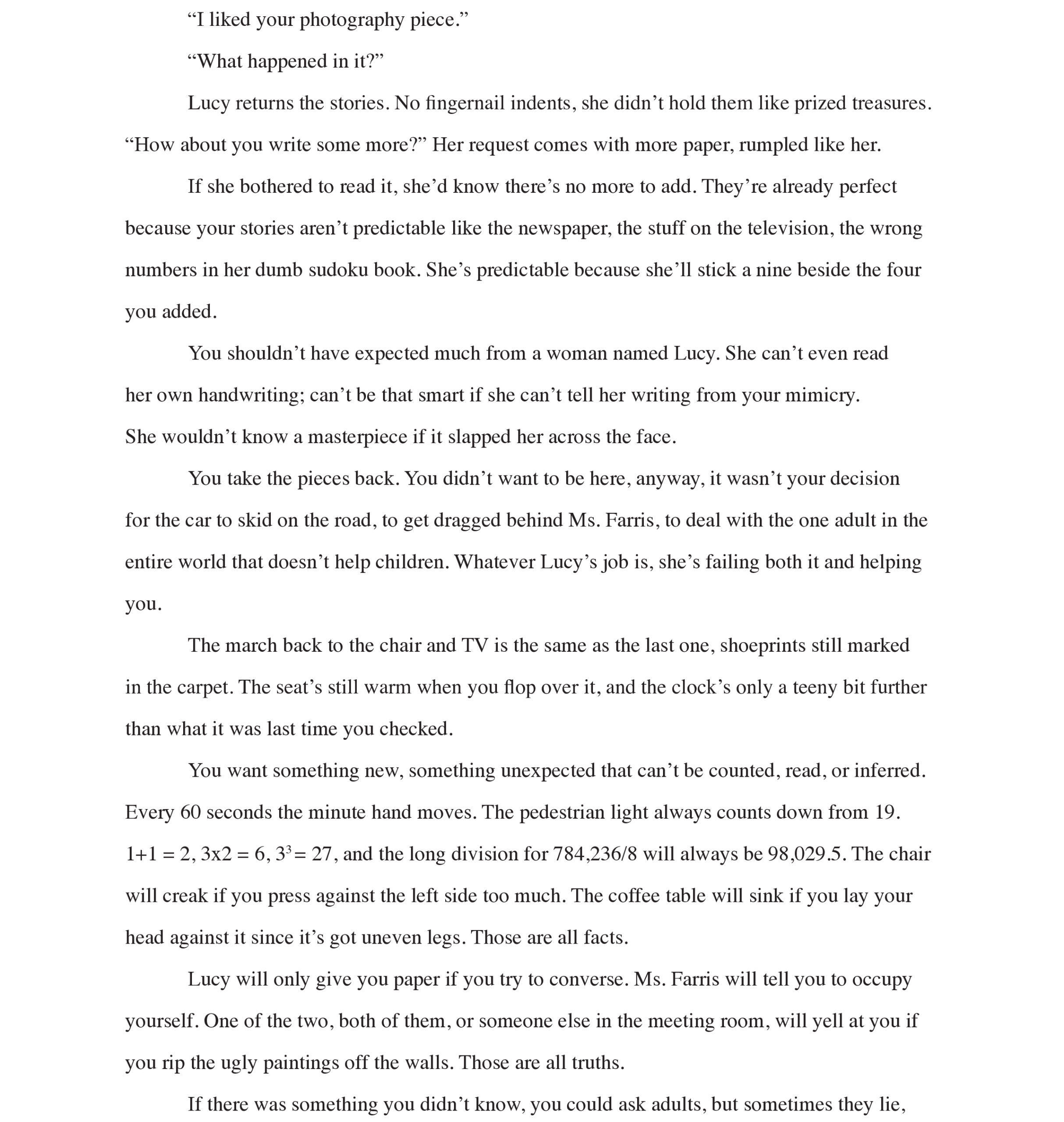
Page 5: “I liked your photography piece.” 
“What happened in it?” 
Lucy returns the stories. No fingernail indents, she didn’t hold them like prized treasures.
“How about you write some more?” Her request comes with more paper, rumpled like her. 
If she bothered to read it, she’d know there’s no more to add. They’re already perfect because your stories aren’t predictable like the newspaper, the stuff on the television, the wrong numbers in her dumb sudoku book. She’s predictable because she’ll stick a nine beside the four you added. 
You shouldn’t have expected much from a woman named Lucy. She can’t even read her own handwriting; can’t be that smart if she can’t tell her writing from your mimicry.  
She wouldn’t know a masterpiece if it slapped her across the face.  
You take the pieces back. You didn’t want to be here, anyway, it wasn’t your decision for the car to skid on the road, to get dragged behind Ms. Farris, to deal with the one adult in the entire world that doesn’t help children. Whatever Lucy’s job is, she’s failing both it and helping you. 
The march back to the chair and TV is the same as the last one, shoeprints still marked in the carpet. The seat’s still warm when you flop over it, and the clock’s only a teeny bit further than what it was last time you checked. 
You want something new, something unexpected that can’t be counted, read, or inferred. Every 60 seconds the minute hand moves. The pedestrian light always counts down from 19.  1+1 = 2, 3x2 = 6, 33 = 27, and the long division for 784,236/8 will always be 98,029.5. The chair will creak if you press against the left side too much. The coffee table will sink if you lay your head against it since it’s got uneven legs. Those are all facts. 
Lucy will only give you paper if you try to converse. Ms. Farris will tell you to occupy yourself. One of the two, both of them, or someone else in the meeting room, will yell at you if you rip the ugly paintings off the walls. Those are all truths. 
If there was something you didn’t know, you could ask adults, but sometimes they lie,
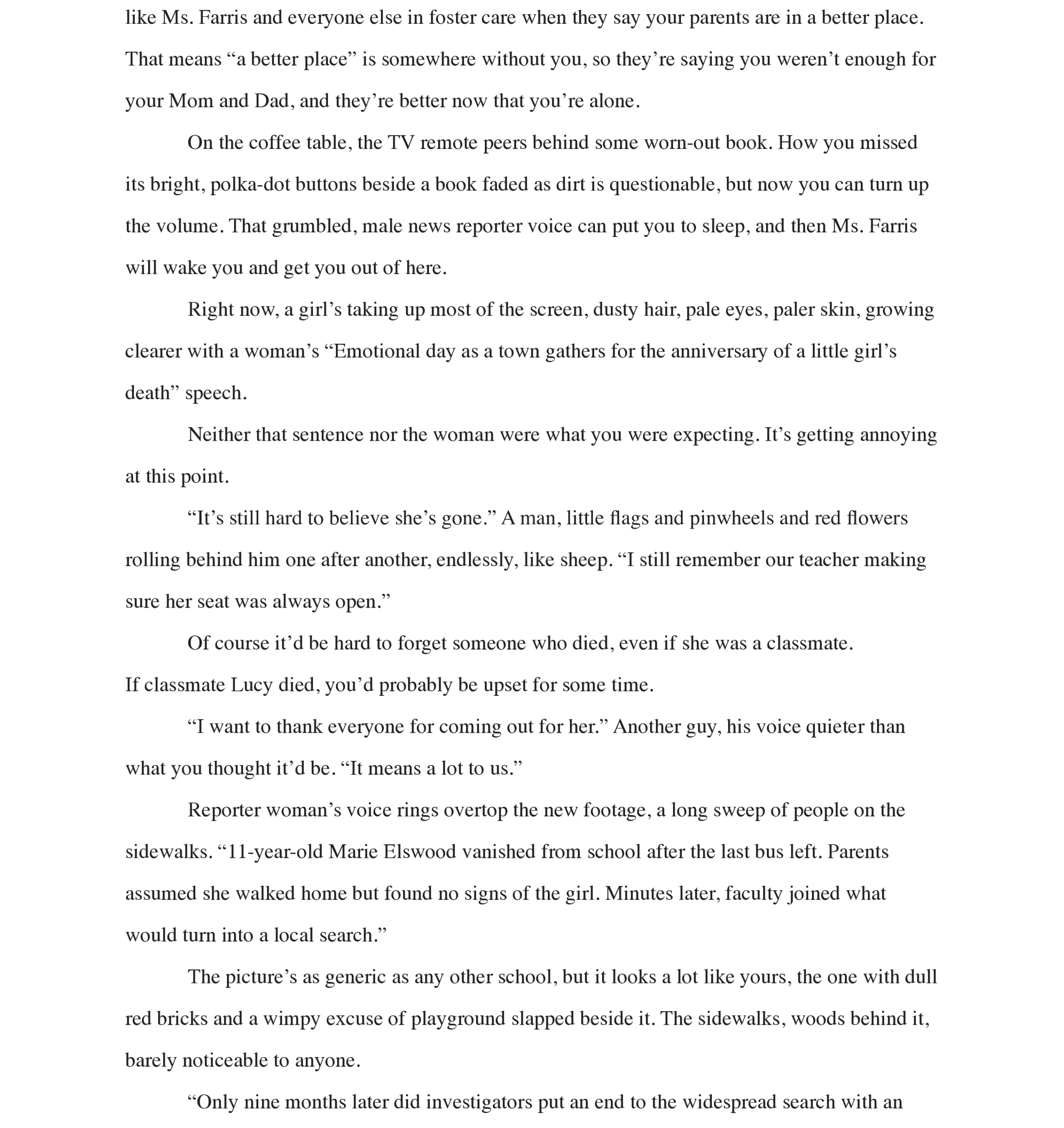
Page 6: like Ms. Farris and everyone else in foster care when they say your parents are in a better place. That means “a better place” is somewhere without you, so they’re saying you weren’t enough for your Mom and Dad, and they’re better now that you’re alone. 
On the coffee table, the TV remote peers behind some worn-out book. How you missed its bright, polka-dot buttons beside a book faded as dirt is questionable, but now you can turn up the volume. That grumbled, male news reporter voice can put you to sleep, and then Ms. Farris will wake you and get you out of here. 
Right now, a girl’s taking up most of the screen, dusty hair, pale eyes, paler skin, growing clearer with a woman’s “Emotional day as a town gathers for the anniversary of a little girl’s death” speech. 
Neither that sentence nor the woman were what you were expecting. It’s getting annoying at this point. 
“It’s still hard to believe she’s gone.” A man, little flags and pinwheels and red flowers rolling behind him one after another, endlessly, like sheep. “I still remember our teacher making sure her seat was always open.” 
Of course it’d be hard to forget someone who died, even if she was a classmate. 
If classmate Lucy died, you’d probably be upset for some time.
“I want to thank everyone for coming out for her.” Another guy, his voice quieter than what you thought it’d be. “It means a lot to us.” 
Reporter woman’s voice rings overtop the new footage, a long sweep of people on the sidewalks. “11-year-old Marie Elswood vanished from school after the last bus left. Parents assumed she walked home but found no signs of the girl. Minutes later, faculty joined what would turn into a local search.” 
The picture’s as generic as any other school, but it looks a lot like yours, the one with dull red bricks and a wimpy excuse of playground slapped beside it. The sidewalks, woods behind it, barely noticeable to anyone.
“Only nine months later did investigators put an end to the widespread search with an
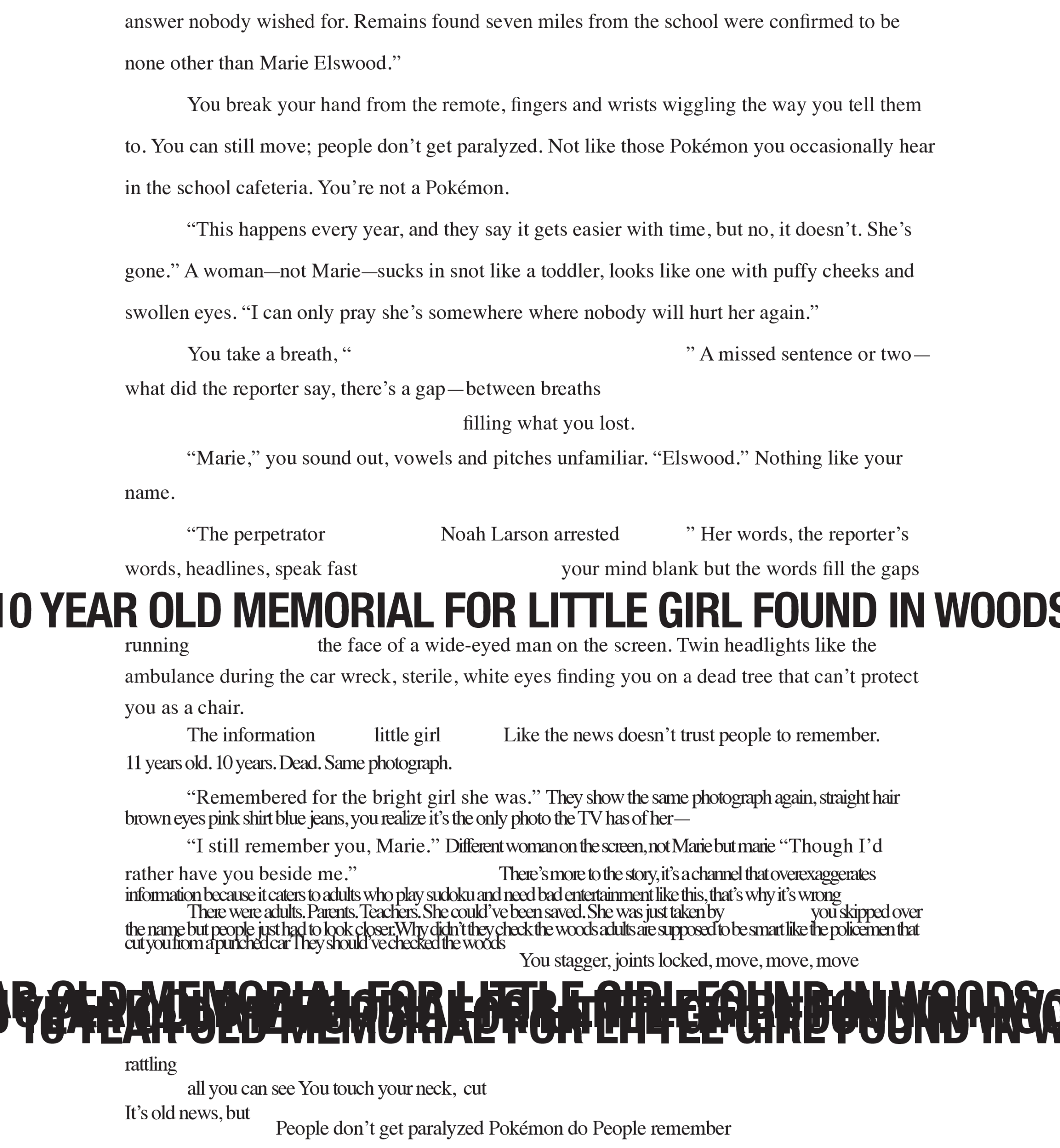
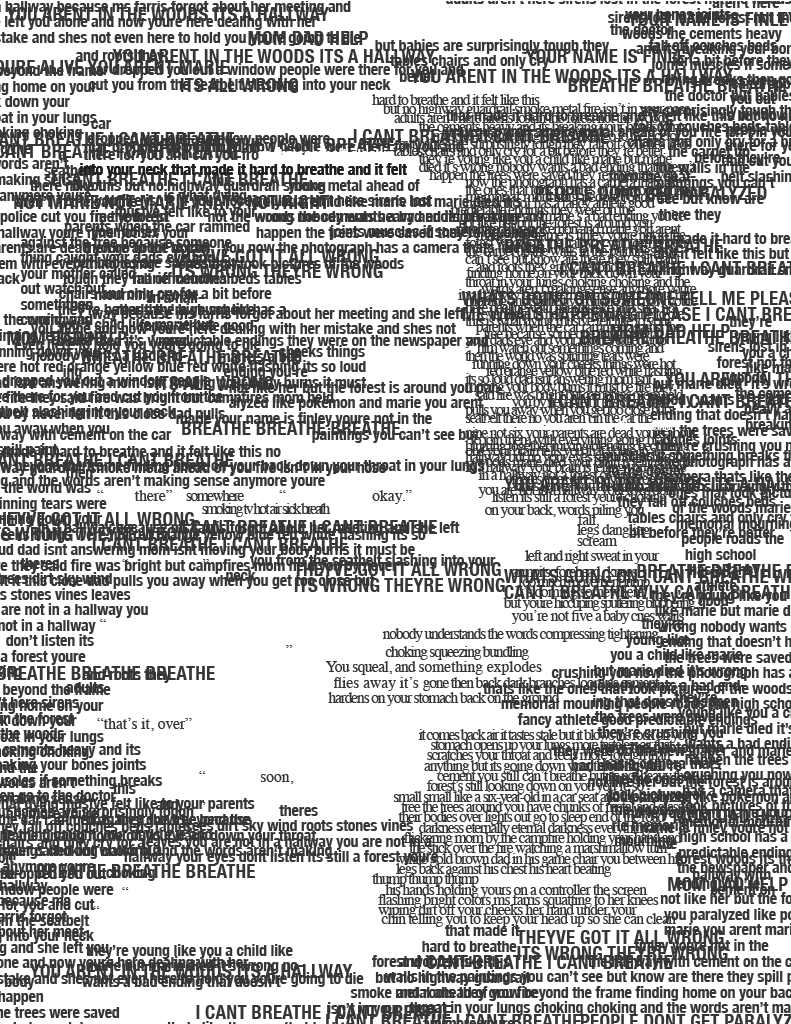
Page 7: (Note before the transcript: the prose begins to be broken up by a headline in large text: 10 YEAR OLD MEMORIAL FOR LITTLE GIRL FOUND IN WOODS)
answer nobody wished for. Remains found seven miles from the school were confirmed to be none other than Marie Elswood.”
You break your hand from the remote, fingers and wrists wiggling the way you tell them to. You can still move; people don’t get paralyzed. Not like those Pokémon you occasionally hear in the school cafeteria. You’re not a Pokémon.
“This happens every year, and they say it gets easier with time, but no, it doesn’t. She’s gone.” A woman—not Marie—sucks in snot like a toddler, looks like one with puffy cheeks and swollen eyes. “I can only pray she’s somewhere where nobody will hurt her again.”
You take a breath, “ 
what did the reporter say, there’s a gap—between breaths 
name.
” A missed sentence or two—
     filling what you lost. 
“Marie,” you sound out, vowels and pitches unfamiliar. “Elswood.” Nothing like your 
“The perpetrator, identified as Noah Larson arrested 
” Her words, the reporter’s 
words, headlines, speak fast 
your mind blank but the words fill the gaps
running
the face of a wide-eyed man on the screen. Twin headlights like the
ambulance during the car wreck, sterile, white eyes finding you on a dead tree that can’t protect 
you as a chair.  
The information  little girl  Like the news doesn’t trust people to remember.  11 years old. 10 years. Dead. Same photograph.
“Remembered for the bright girl she was.” They show the same photograph again, straight hair brown eyes pink shirt blue jeans, you realize it’s the only photo the TV has of her—
“I still remember you, Marie.” Different woman on the screen, not Marie but marie “Though I’d rather have you beside me.”    There’s more to the story, it’s a channel that overexaggerates 
There were adults. Parents. Tinformation because it caters to adults who play sudoku and need bad entertainment like this, that’eachers. She could’ve been saved. She was just taken by  s why it’s wrong you skipped over 
  cut you from a punched car  the name but people just had to look closer  .They should’ve checked the woodsWhy didn’         t they check the woods adults are supposed to be smart like the policemen that 
You stagger, joints locked, move, move, move
rattling
all you can see You touch your neck,  cut
It’ s old news, but     People don’t get paralyzed Pokémon do People remember
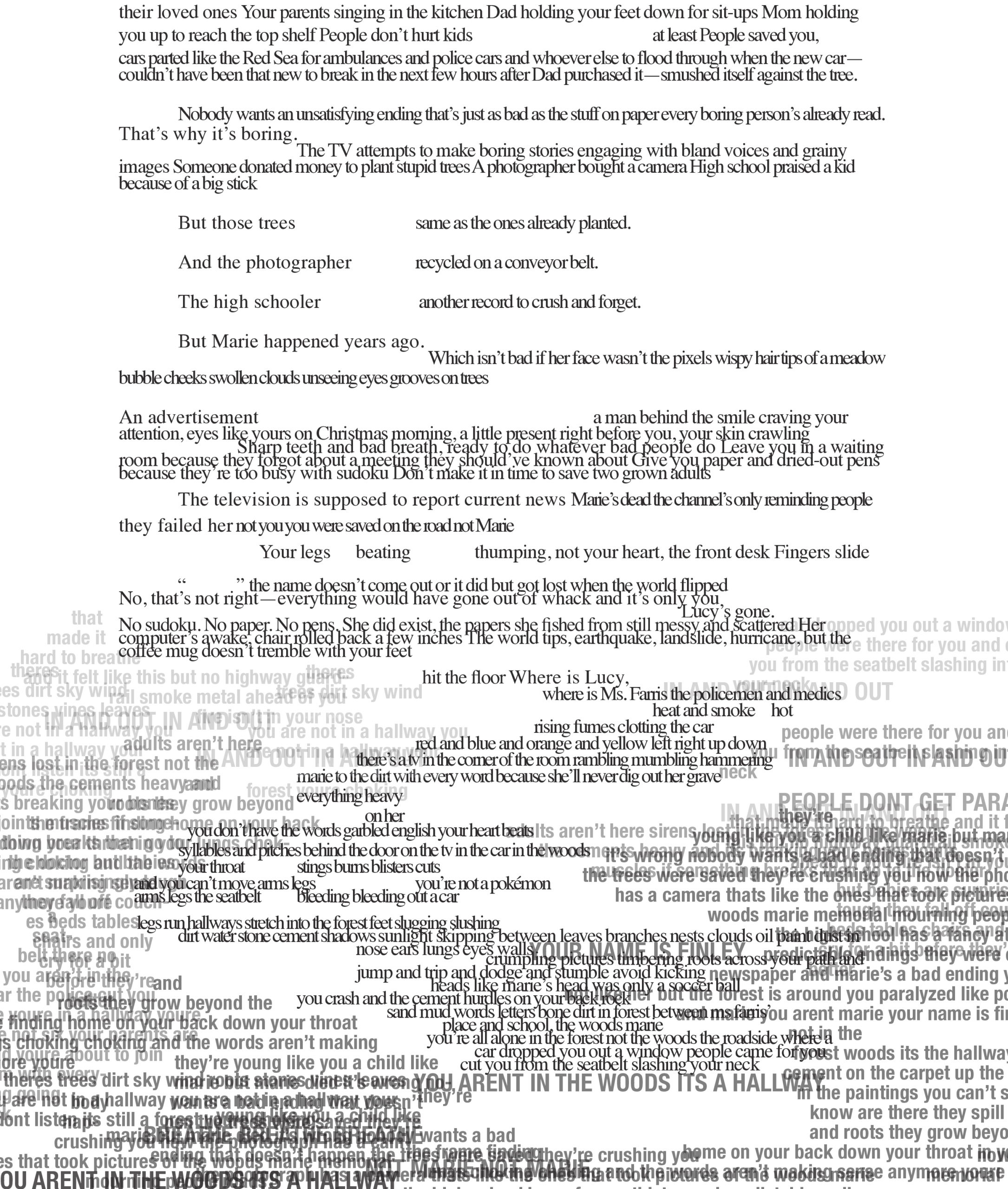
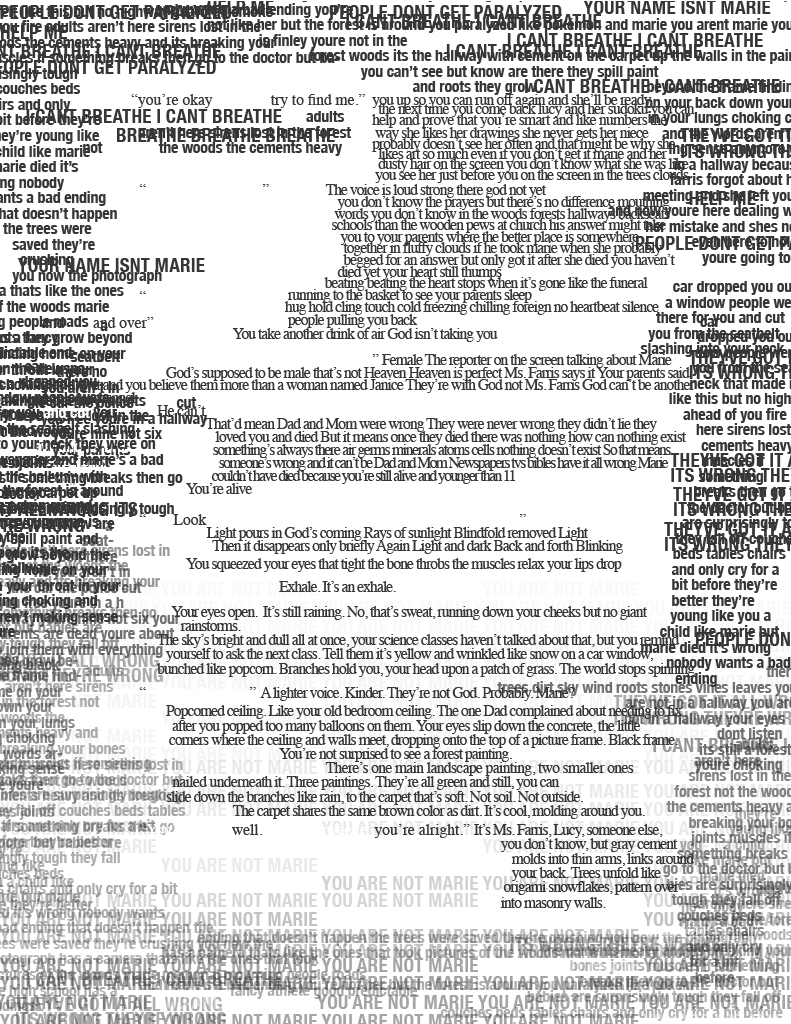
Page 8: (Note before the transcript: the prose continues to be broken up by overlapping, unreadable text indicative of a panic attack or repressed memories)
their loved ones Your parents singing in the kitchen Dad holding your feet down for sit-ups Mom holding you up to reach the top shelf People don’t hurt kids    at least People saved you, 
cars couldn’parted like the Red Sea for ambulances and police cars and whoever else to flood through when the new car—t have been that new to break in the next few hours after Dad purchased it—smushed itself against the tree. 
Nobody wants an unsatisfying ending that’s just as bad as the stuff on paper every boring person’s already read. 
That’ s why it’ s boring. The TV attempts to make boring stories engaging with bland voices and grainy images because of a big stickSomeone donated money to plant stupid trees A photographer bought a camera High school praised a kid 
But those trees  And the photographer The high schooler 
same as the ones already planted. recycled on a conveyor belt. 
 another record to crush and forget. 
era
   But Marie happened years ago.     Which isn’t bad if her face wasn’t the pixels wispy hair tips of a meadow
bubble cheeks swollen clouds unseeing eyes grooves on trees
An advertisement    attention, eyes like yours on Christmas morning, a little present right before you, your skin crawling  a man behind the smile craving your  
   Sharp teeth and bad breath, ready to do whatever bad people do Leave youaper and dried-out pens in a waiting because theroom because they fory’re too busy with sudoku Don’got about a meeting they should’ve known about Give you pt make it in time to save two grown adults 
The television is supposed to report current news Marie’s dead the channel’s only reminding people  they failed her not you you were saved on the road not Marie
  Your legs beating  thumping, not your heart, the front desk Fingers slide
No, that’“          ” the name doesn’         s not right—everything would have gone out of whack and it’t come out or it did but got lost when the world flippeds only you      Lucy’  s
computer’No sudoku. No papers awake, chair rolled back a few inches . No pens. She did exist, the papers she fished from still messyThe world tips, earthquake, landslide, hurri and scattergone. 
that 
coffee mug doesn’t tremble with your feet
their loved ones Your parents singing in the kitchen Dad holding your feet down for sit-ups Mom holding you up to reach the top shelf People don’t hurt kids    at least People saved you, 
cars couldn’parted like the Red Sea for ambulances and police cars and whoever else to flood through when the new car—t have been that new to break in the next few hours after Dad purchased it—smushed itself against the tree. 
Nobody wants an unsatisfying ending that’s just as bad as the stuff on paper every boring person’s already read. 
That’ s why it’ s boring. The TV attempts to make boring stories engaging with bland voices and grainy images because of a big stickSomeone donated money to plant stupid trees A photographer bought a camera High school praised a kid 
But those trees  And the photographer The high schooler 
same as the ones already planted. recycled on a conveyor belt. 
 another record to crush and forget. 
era
   But Marie happened years ago.     Which isn’t bad if her face wasn’t the pixels wispy hair tips of a meadow
bubble cheeks swollen clouds unseeing eyes grooves on trees
An advertisement    attention, eyes like yours on Christmas morning, a little present right before you, your skin crawling  a man behind the smile craving your  
   Sharp teeth and bad breath, ready to do whatever bad people do Leave youaper and dried-out pens in a waiting because theroom because they fory’re too busy with sudoku Don’got about a meeting they should’ve known about Give you pt make it in time to save two grown adults 
The television is supposed to report current news Marie’s dead the channel’s only reminding people  they failed her not you you were saved on the road not Marie
  Your legs beating  thumping, not your heart, the front desk Fingers slide
No, that’“          ” the name doesn’         s not right—everything would have gone out of whack and it’t come out or it did but got lost when the world flippeds only you      Lucy’  s
computer’No sudoku. No papers awake, chair rolled back a few inches . No pens. She did exist, the papers she fished from still messyThe world tips, earthquake, landslide, hurri and scattergone. 
that 
coffee mug doesn’t tremble with your feet
Page 9: (Note: No complete transcription here, this page is a continuation of the overlapping text. Repeated phrases such as "BREATHE BREATHE BREATHE" and "YOU AREN'T IN THE WOODS ITS A HALLWAY" can be made out between the overlapping text
Page 10: (Note in lieu of a complete transcript: The overlapping phrases begin to clear slightly, begin to fade into the background as the protagonist begins to calm down
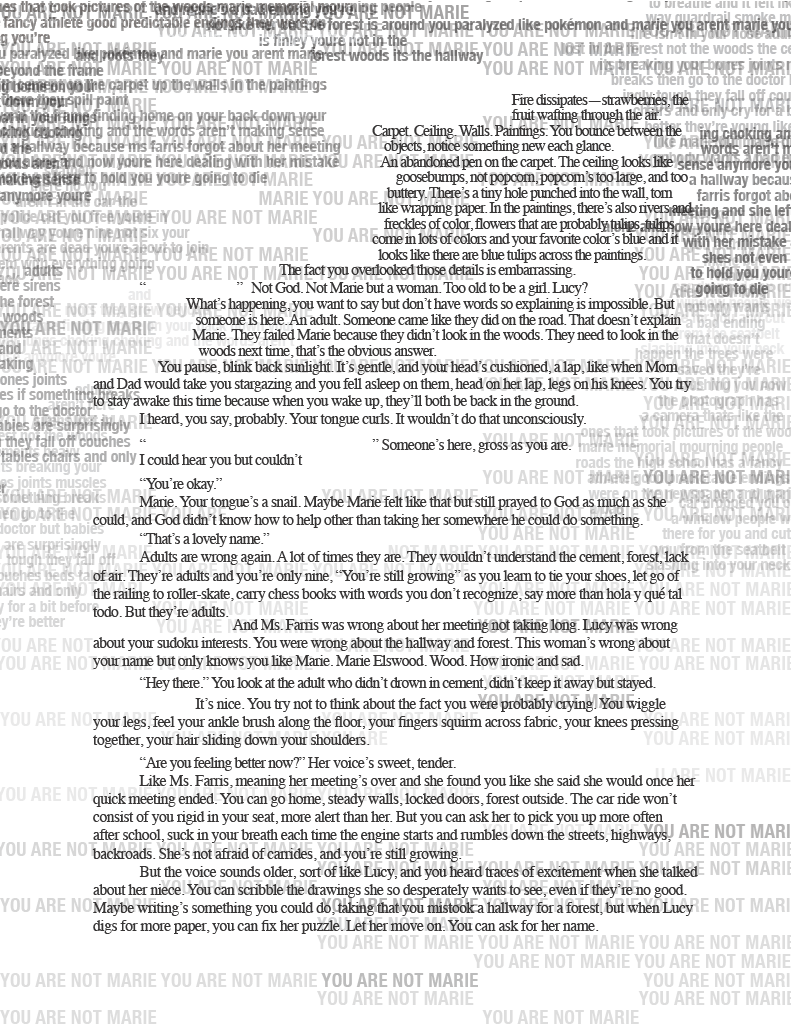
Page 11: (Note in lieu of the transcript: the overlapping phrases continue to fade out until only one phrase in the background remains repeating: "YOU ARE NOT MARIE" as the protagonist returns to the present in the office.)
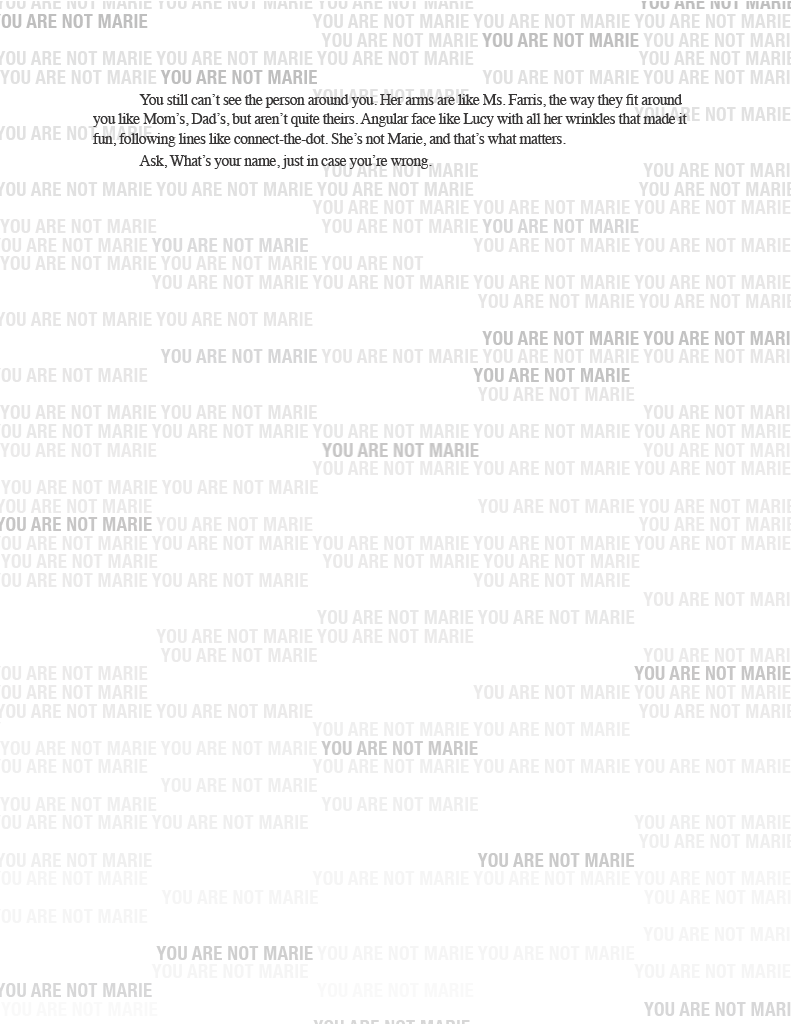
Page 11: (Note before the transcript: the overlapping phrases continue to fade out until only one phrase in the background remains repeating: "YOU ARE NOT MARIE")

RI RE NOT MARIE
You still can’t see the person around you. Her rams are like Ms. Farris, the way they fit around you like Mom’s, Dad’s, but aren't quite theirs. Angular face like Lucy with all her wrinkles that made it fun, following lines like connect-the-dot. She’s not Marie, and that’s what matters. 
Ask, What’s your name, just in case you're wrong